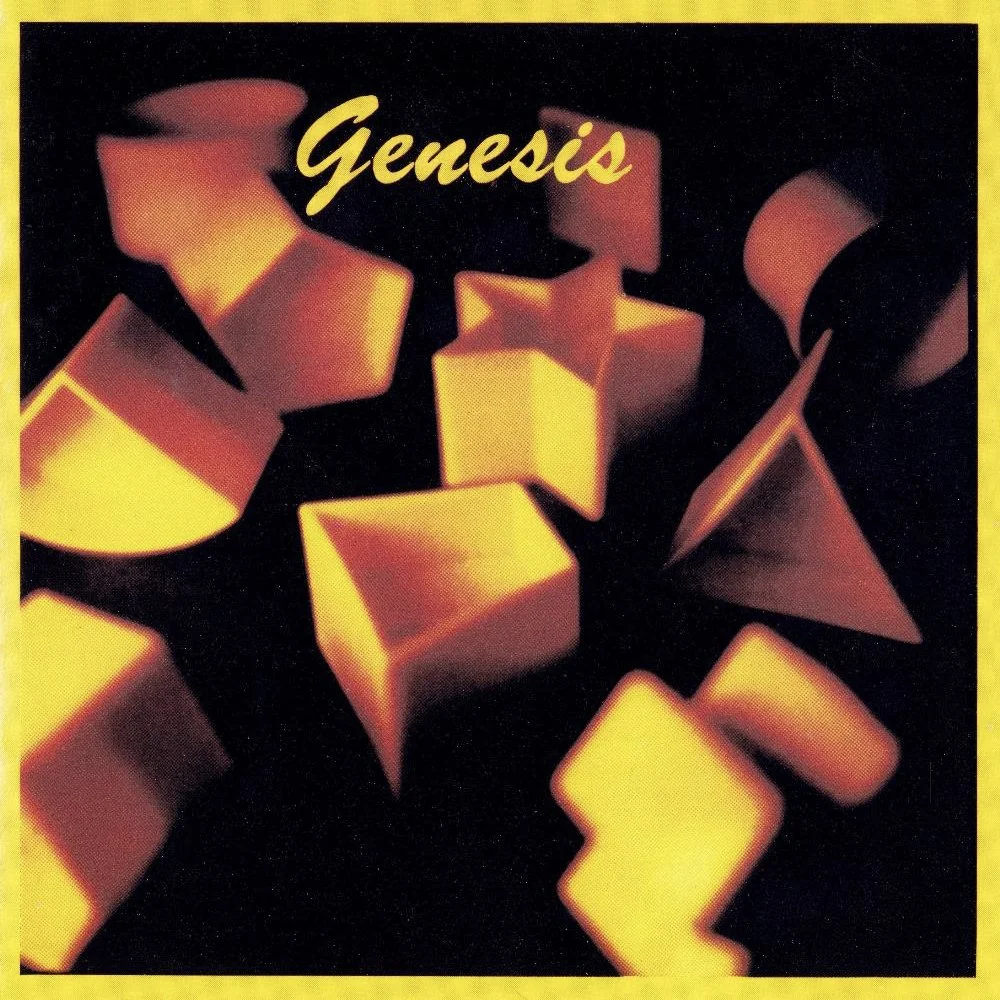
Thoughts On: Genesis

by Bryce Napier

Genesis

released October 3, 1983

Atlantic Records

The layers of mental baggage I carry around concerning Genesis make it nearly impossible to discuss them without a second luggage cart full of asterisks and caveats.

From childhood through my preadolescent years, the influences that shaped my musical tastes could be expressed in diagram form by drawing a straight line down from my brother (two and a half years my senior) to me. I don’t think I was trying to ingratiate myself with him by adopting his preferences, or anything disingenuous like that; there just weren’t any other people in my life who were deeply into music, and I usually ended up liking what I was introduced to through him.

Genesis was different. Perhaps started as a failsafe against overlap with what my brother might pick when being allowed to choose a record to buy, I staked a claim on Genesis as a band that made music I liked. It may have been because my brother expressed a liking for them without quite being interested enough to acquire the albums; honestly, I don’t remember. Nonetheless, Genesis felt like “my” band, and was the first act to ever feel that way. Which is not to suggest that there weren’t complications. The layers of mental baggage I carry around concerning Genesis make it nearly impossible to discuss them without a second luggage cart full of asterisks and caveats.

For instance: Naively secure in my Genesis fandom, on one of those mid-‘80s record expeditions I confidently selected a Genesis album called Trespass. Upon listening to it for the first time, I hated it. Like, super-hated it. I was sure that they had pressed the wrong music on the vinyl, or that I’d accidentally gotten an album by a band called Trespass that had been misfiled under the album title, as it didn’t sound remotely like Genesis. This is when I learned that the band I thought of as Genesis—a trio comprising Phil Collins, Mike Rutherford and Tony Banks—had gradually evolved from a five-piece fronted by some dude called Peter Gabriel. If you’ve ever had a sip of iced tea when your taste buds were anticipating apple cider, you have some idea what I experienced. Tea can be great if that’s what you’re thirsty for, but in that moment of dashed expectations, it tastes like an abomination. Now imagine this was your very first exposure to iced tea. Because when it comes to Gabriel-era Genesis, I’ve never fully gotten that flavor of betrayal out of my mouth. It even resonates for me in Gabriel’s solo work. I think So, from 1985, is one of the greatest albums ever made, but the further you slip into his back catalog—the closer to song titles like “Moribund The Burgermeister”—the less I enjoy his work.

Phil Collins’s Genesis is unquestionably more popular than the Peter Gabriel version. Each of their last three albums—individually—outsold the entire six-album run of the Gabriel era. It’s possible that *every* album they released in the 1980s achieved that feat. However, as some illustrious person once said: popularity is the hallmark of mediocrity. The burgeoning music snob inside of me couldn’t reconcile that people who connected purposefully with music generally held the exact opposite opinion to mine; they felt that the real Genesis was the arty prog-rock ensemble led by Gabriel, and their subsequent albums just got more schlocky and embarrassing as time went on, sullying the legacy of a once-great band. As someone who would rather listen to “Paperlate” three times back-to-back than invest nine minutes of my life hearing “Firth Of Fifth” just once, it broke me a little to be lumped in with the uncultured masses.

By 1985, I was feeling quite a bit of embarrassment about my favorite band being Genesis. To compromise, I declared 1980’s Duke—a good album, an album I like—to be my favorite Genesis record, because it at least somewhat hearkened back to the early sound, and had some standing within the ranks of the Gabriel loyalists. Really, though? The self-titled smash hit record from 1983 is—and has always been—where it’s at.

It’s a curious thing when a long-running act decides to eponymously title an album deep into their discography. It always suggests to me that they believe themselves to have made a definitive statement, to have finally stumbled upon what they were always meant to become. In this case, they did it to stress the band’s identity over that of its individual members—most notably, of course, Collins, who had emerged since their previous album as a star in his own right—by having written the whole album as a unit, in their own recording studio in Surrey, christened The Farm.

Immediately undercutting their “We are Genesis” mission statement, though, the album opens with the song “Mama.” I think it’s a great track, but it feels more than a little like trying to Frankenstein together two recent Genesis-affiliated-but-ain’t-Genesis opening tracks: “Intruder,” from Peter Gabriel’s third solo outing; and “In The Air Tonight,” from Phil Collins’s Face Value. Tonally, it’s very much “Intruder,” with its creeping menace and unsettling subject matter. Structurally, it’s all “In The Air Tonight,” building in intensity, riding programmed drums through half of the song before allowing Collins’ thunderous drums to crash the party. And speaking of thunderous drums, the band brought Hugh Padgham along for the ride, who had engineered/produced both of the aforementioned songs, and created the now-infamous gated-drum sound that ruled the decade.

Frankly, it was a weird choice for a single, let alone the lead single for the album. The band members have described it as being a disturbed young man projecting his mother issues onto a prostitute who, naturally, has no feelings for him, but the actual lyrics don’t indicate the presence of a mother figure. It sounds like he’s got his actual mother tied up, berating her because she won’t have sex with him. The vocals become increasingly unhinged with loose repetition, and nothing gets resolved. It feels weird to call a deranged Oedipal breakdown a good song, but I do find it effective. That it can weather all the criticism I just threw at it and remain, to my mind, a great track, is a testament to its resilience. It was a Top Ten hit in loads of countries, too. It hit #4 in the UK, which is their highest singles chart showing ever there. It’s bizarre.

The second track (and also second single) is the much more conventional “That’s All.” It might be the only song on the record that’s not an elaborate set piece. It’s a midtempo lament about a guy who can’t seem to leave a relationship where he and his partner never seem to be happy with each other. Pretty straight love-gone-wrong song. This was the bigger hit in the US. It’s a pretty good little hook, but feels lightweight in comparison to everything else here.

The star of the show is “Home By The Sea” and its (mostly instrumental) companion piece, “Second Home By The Sea.” A “Hotel California”-type tale of a thief breaking into an abandoned house only to find he can never leave, it’s evocative without being heavy-handed. I can take paranormal underpinnings much more easily than fantasy references to enchanted forest creatures and such. The slightly-spooky melancholy pervades even the instrumental sections, and amounts to eleven minutes of goodness that demonstrates that I’m not allergic to long songs in and of themselves; it just needs to feel like a cohesive ride.

The album’s messiest legacy comes next, in the form of “Illegal Alien.” It’s both a super-catchy singalong and a (mind-bogglingly, through the modern lens) poorly-executed idea. My understanding is that the original inspiration came from their own difficulties in obtaining visas. So their first misstep was to creatively interpret that bureaucratic hassle as a feeling of being treated like ne’er-do-wells trying to sneak into the country. The second mistake was to solidify that narrative by casting themselves as Mexican characters trying to get into the US. The third was to gleefully populate this story with every lazy Mexican stereotype you can think of. And the fourth was, God help me, singing it in a bandito accent. Is good-natured racism a thing? I don’t think harm was meant (the protagonist is presented as something of a lovable scamp, no threat to anyone). Nor do I believe harm was, at the time, done. But then, I suppose that’s not my place to say. It wasn’t the first time Phil had adopted a dodgy accent to get into character; I didn’t even mention the demonic-Yoda-thing he did on “Mama.” Still, if your satire can be ingested at surface level that easily—enough so that those you disagree with could adopt it as an anthem; enough so that American Psycho’s Patrick Bateman has nothing but good things to say about it—then it was not particularly good satire. So I’m left feeling bad about kind of liking a song that is difficult to defend—that I don’t even want to defend—off of an album I do want to defend, by a band I loved but was embarrassed to admit that I liked, before hitting the same Phil Collins saturation point as much of the general public in the mid-to-late ‘80s; until, decades later, coming back around to it. I’m telling you, my pinballing feelings about Genesis on a band, album, and individual song level make the music almost impossible to assess with clarity.

The heavy-hitters all reside on side one. “Taking It All Too Hard” opens the second half, and was also a single, but is just a generic ballad that doesn’t sound much different from what Chicago or a dozen other AOR bands could have produced at the time. It doesn’t strike me as bad or hard to listen to. It’s competent. It’s just kind of there. “Just A Job To Do” is another one-act scenario: a hitman carrying out a contract on another hitman. It’s not really a character study; there’s no insightful reflection on the nature of the business, or paranoia about whether someone will come after him after the job is done. It’s a five minute gonna-getcha taunt. I like it, though I wouldn’t call it a highlight.

“Silver Rainbow” is interesting to me. It plays to me like a fever dream about a fever dream, with a loping, looping keyboard line nimbly bouncing off a driving drum pattern, coming together in lockstep for the chorus. Collins sings (more or less) about how lust and love eventually combine into a transcendent reality that indicates when lovers have truly connected. A bit silly, I suppose, but it’s a dark horse favorite. The closer, “It’s Gonna Get Better,” has always hit me like an extension of “Silver Rainbow.” It’s much lighter, but carries on the disorienting floaty-ness of the previous track. It doesn’t send the record off with a dramatic game-winning grand slam home run. It just drifts ever further into the ether until you can’t see it anymore. It almost doesn’t register to me as a song—just a very long coda. I like it well enough, but it’s one of those songs that I can never remember how it goes unless I’m currently listening to it.

I haven’t mentioned much about musicianship. That’s because it doesn’t stand out to me—and I mean that in the best way possible. I’ve listened to this album half a dozen times in the past month, not to mention the scores upon scores of times I played it as a kid, where I bonded with it on a molecular level. Yet I still couldn’t tell you if there are showcase solos on this album. I don’t think there are. There’s a restraint there to craft the songs with exactly what they need, without leaving wide open spaces for the look-at-what-I-can-do noodling that puts me off prog. Even the instrumental “Second Home By The Sea” is carried by a keyboard line simple enough that I learned to play along with it as a teen—and I suck at keyboards. This record flows through me, where the bass on this song might catch my ear on a particular play-through, or a turn of phrase on that song. But they never become the primary things that I notice from that point forward when I hear them. I’ve been intimately close to it, and also completely forgotten about it for years at a time. But there’s no denying, at long last, complicated history be damned, that it is a foundational block of my musical identity.

Thoughts On: Rockin' The Suburbs

by Bryce Napier

Rockin’
The Suburbs

Released September 11, 2001

Epic Records

They are genuinely things that bothered me, but it also seems that, in some ways, my expectations regarding Ben Folds were, at the time, unfairly high.

Rockin' The Suburbs, released in 2001, feels like Ben Folds priming for superstardom. He’s billed as a solo artist, a subtle but significant change from his first three albums, all released under the band name Ben Folds Five. That combo (actually just a trio—they decided Ben Folds Three just didn’t have the same ring to it) had a gimmick that was never intended to be one: they had no guitarist. Ben played piano, Darren Jessee played drums, while Robert Sledge’s bass was cranked up to fuzzy extremes to fill in the aural gaps left by the lack of guitar. Even though there were two open slots available in the band name, the addition of a full-time guitarist would have betrayed the constrictive “rules” established by their signature sound. Going solo opened up his options.

Whether Rockin’ The Suburbs had the stuff to launch Folds into the pop stratosphere, we’ll never know for sure, since it had the misfortune to be released on September 11th of that year. By the time the general populace was ready to think about things other than 9/11, the album was already old news. Certainly it was for me. In fact, despite having chosen my representative favorites years ago, I’m only now giving pointed consideration to its position in the pantheon. (It was taking way too many words to adequately describe just what the first two Ben Folds Five records meant to me personally; suffice to say that they supply the benchmark to which the rest of his work is compared, and those comparisons have not been favorable.) To me, the Ben Folds/Five catalogue—nine-plus albums to date, depending on what you’d classify as an album—have been spotty in terms of quality after the first two records, and reside on a much lower rung of my esteem. I’ve culled a keeper or two from most of the titles, but I’ve long found them difficult beginning-to-end listening. I’m just coming to realize that circumstance may have prevented Rockin’ The Suburbs from ever getting its fair shake, though. Especially with me.

For the most part, the songwriting on Suburbs is not a vast departure from the musical sensibilities of the songs he recorded with the Five. Yet those sensibilities manage to get both streamlined and broadened here. From a musical standpoint, the early tunes were frenetically melodic. Songs shifted gears restlessly, boasting as many ideas as the band could cram into them. Rockin’ The Suburbs eases up on this substantially, trading in some of the rollercoaster factor for laser-focused craftsmanship.

Lyrically, Folds has always been about pulling off the scabs of the human condition to poke at the raw skin underneath, usually via character sketches and break-up songs. This was balanced, however, with wiseass snark, full songs that felt like they were built from in-jokes, mostly written to feed his own amusement. With the (somewhat painful) exception of the title track, Rockin’ The Suburbs dispenses with the latter type of song completely, and massages the character sketches into something more archetypal. This has the effect of making them less personal, less like portraits of people he knows in his life, which costs them some of their observational nuance, but perhaps makes them easier for more people to relate to.

The opening track, “Annie Waits,” is a perfect example of this evolution, both lyrically and musically. It kicks in with big, simple piano chords, punctuated by a handclap. He sings a verse over this simple riff, then sings a second with an additional Casio-style beat. At forty seconds in, the full band comes enters without deviating from the previously built groundwork. Eventually it moves into a bridge and a chorus (though even the chorus returns to the original riff, just with a new melody over the top of it), but it’s all in service of a tight pop song, and not as a showcase for Folds’s crazed soloing. Annie’s story, such as it is, is that she’s wondering if she’s being stood up, as her ride (and date, presumably) has neither shown up nor called her. There’s a light twist at the end, where the seemingly omniscient narrator turns out to belong to an actual person lamenting that Annie is not waiting for him instead. It feels a little like a not-sure-what-to-do-with-this ending; I don’t know that I think it works, and the lack of lyrical bite prevents it from being great, in my estimation. But the song itself is a total earworm, and a strong start to the album.

“Zak And Sara” continues the character-sketch format (six of the first eight songs on the record feature a person’s name in the title), but also brings up one of the reasons I suspect this record didn’t resonate with me sooner—I can’t make out the lyrics so easily, either the actual words or the intent. In fact, before putting the album on the microscope this week, I had no idea what the song was even about. Even now, after reading through the lyrics, I’m not entirely sure. Zak seems to be trying to impress/cheer up/connect with Sara by playing her a song while she mentally drifts away. Are they a couple? Is she sad because of Zak, or did she go somewhere with him to escape home life? It’s all so opaque and open to interpretation, which I’m not used to with Ben Folds lyrics. Musically, it’s rollicking and upbeat, and sounds like it could have easily fallen off a Ben Folds Five record. (Although that leads to a singularly dubious moment in the middle of the song, where a line about Sara pretending she doesn’t hear voices in her head “because at home they got her smacked” is immediately followed by a jaunty set of handclaps.) It’s fine—it’s good, even—but didn’t rope me in with its thematic hook, because I couldn’t (and still can’t) tell what its thematic hook was.

The problems get amped up a little more on “Still Fighting It,” which seems to have two wildly different and incompatible interpretations, either of which would be powerful message songs if only the specific meaning was made a little more clear. It seems to be about a father/son moment, the father seeing himself in the behaviors of his son, trying to explain the passage of time to the kid, marveling how much time has passed that he could have a son of his own, and how the son will experience the same passage of time. On the other hand, it also kind of seems to be about buying a meal for a homeless veteran, who’s “still fighting” a war in his mind, and the hope that this act of kindness might help set him right, and get back on his feet. And it’s weird that I can’t nail down one of these two divergent narratives, right? Folds can be very good at a heart-on-sleeve lyric (it’s one of my favorite things about him as an artist), at laying bare our collective vulnerabilities with a plainspoken turn of phrase, but I feel like it missed the mark here.

Perhaps the biggest reason I’d never thoroughly absorbed those first three songs is that I’d usually cue up the album to start at track four. Because, man, I love “Gone.” It’s one of the very few Ben Folds songs that easily matches my love for his first two albums. “Gone” takes a simple 1950s doo-wop structure and turns it into a pounding 6/8 singalong. And it’s a break-up song, one of his bread-and-butter formats. My takeaway is something like this: Okay, we weren’t good as a couple, but I don’t think that means we need to stop knowing each other entirely. However, that’s your call to make. “I hope you’ll find some time to drop a note / But if you won’t / then you won’t / And I will consider you gone.” It’s a little wounded, a little defiant, and a lot of cathartic fun to sing. I once made a Ben Folds mix to introduce a friend to his music, and this was my choice for a grab-em-by-the-throat opener. Top stuff.

“Gone” is immediately followed by one of his most poignant songs, a lilting piano and cello duet in waltz time titled “Fred Jones Part 2,” solidifying this middle stretch of the record, for me, as its heart. We finally get a character sketch that feels relatable, not because it’s vague enough to be applicable to everyone, but because it paints a specific picture of a universal fear. Mr. Jones is being forced into early retirement, observing that “no one is left here that knows his first name,” and he tries to gracefully accept it, doing the kind of thing he thinks retirees are supposed to do. He tries his hand at painting, and not until he assesses the finished product (“it doesn’t look right”) does he finally erupt: “…These bastards have taken his place / He’s forgotten but not yet gone.” There’s no narrative resolution, nothing to give it a silver lining; nothing but Fred’s gradual realization that he spent his adult life doing work that didn’t matter for people who didn’t care. Devastating, and devastatingly good.

After that one-two punch, it falls back into the territory of the first part of the record. “The Ascent Of Stan” is a mildly amusing portrait of a hippie forced to confront the fact that adult responsibilities have turned him into the kind of person he used to protest against. I don’t know what “Losing Lisa” is about. It strolls along at a Billy Joel-ish gait, has a chorus that talks about “black tears … falling down her face,” and doesn’t sound anywhere near as dire as that title and quoted lyric would suggest. The similarly-titled “Carrying Cathy” is the only thing that strikes me as a lyrical mis-step. A mawkish tale with “clever” wordplay, Cathy is a fragile girl who is always leaning on emotional support (thus being “carried”), but ultimately commits suicide, and in the end her remaining family have to cart her coffin (get it? they’re literally carrying her! hey! hey! do you get it?) down the gravesite for burial. His lyrics aren’t known for their subtlety, but there’s an art to their artlessness, and the sledgehammer they wield comes from rawness and insight, not weepy melodrama with a heavy-handed twist.

There’s another four songs on the record, but only two more with standout personalities for me.  (For the record, the two I’m skipping are called “Not The Same” and “Fired.” They’re fine.) The title track is the most curious song on the record for several reasons. There’s the sound of it: it’s guitar driven. If there’s piano, it’s buried in the mix, and the prominent keys are organ (or electric piano, or Mellotron, or synth—apologies that I can’t always identify keyboard-based instruments by sound alone, but there’s a couple of different types in here). That alone makes it a significant departure. Then there’s the tone of it, a return of the snarky frat boy voice that informed a lot of Ben Folds Five records. He’s teasing the existential angst of those who have it pretty good, lamenting, “ya’ll don’t know what it’s like / being male, middle class and white.” And though there’s profanity sprinkled throughout the record, it’s concentrated and pointedly self-conscious here, as when he repeats, “You better look out, because I’m gonna say ‘fuck!’” The language alone makes it a strange to choice to feature it so heavily—it provided the album title, after all, and was the primary single. While the tempos and dynamics rise and fall over the course of the album, the tone is fairly sober throughout, except for this one song. I do like the lightweight silliness of it, but figuring in the timing of 9/11 makes it almost cringe-inducing to imagine it airing at the time. A shift of marketing gears would have seemed exploitative (and, frankly, would have been), and so it feels like it the record was left to die on the vine, but literally any other song on the album could have cradled the national mood after the tragic events of that day.

Case in point: “The Luckiest,” which closes the album. It is awash in hope and hopelessness in equal measure. It is another percussion-free arrangement; just strings, piano and voice. It is love and loss wrapped in free-associative non sequiturs, and really a beautiful song. I have a personal memory locked to it as well: When my brother-in-law and his wife lost their newborn son in 2008, they asked me to put together a slideshow memorial to remember him by, and this was the song I chose to play over it. It seemed to capture what they were trying to express in the aftermath of this crushing blow—that, even knowing how it was going to end, they wouldn’t have wished away his short life to spare themselves the pain of his loss. So, yeah, I can’t hear it now without thinking of them, and it chokes me up a little. But I could have seen it being embraced as a salve in post-9/11 America, had it been given the chance to pervade the public consciousness.

It seems like I’ve nitpicked a lot over the album, as a whole, which I have. These nitpicks are, I think, what got the record stuck in the purgatory of ambivalence for so long. They are genuinely things that bothered me, but it also seems that, in some ways, my expectations regarding Ben Folds were, at the time, unfairly high. There are records that aim a lot lower—that don’t try to pitch an idiosyncratic point of view with every song—which I love unconditionally, nitpicking be damned. Making a point of listening to it recently, far-removed from the context of September 11th, has enabled me to hear it with fresh ears. The music is outstanding. There’s not a single track that sounds less than fully-formed. I think I’m ready to induct Rockin’ The Suburbs into my inner circle of favorite albums.

Thoughts On: Sheer Heart Attack

by Bryce Napier

queen-sheerheartattack.jpg

Sheer Heart Attack

released November 12, 1974

Elektra Records


For decades, ‘Now I’m Here’ bolstered my idea of Sheer Heart Attack as ‘Killer Queen’ plus filler Queen.

I've been re-evaluating my opinion of this record. Released in 1974, a scant eight months after Queen II, Sheer Heart Attack didn’t exactly find Queen firing on all cylinders, but I think it’s where they collectively worked out just what made their engine run. Over time, it has solidified as a dark horse favorite of many fans. It has long since climbed out of the basement of my own estimation, but will a closer look promote it into my top tier of Queen albums?

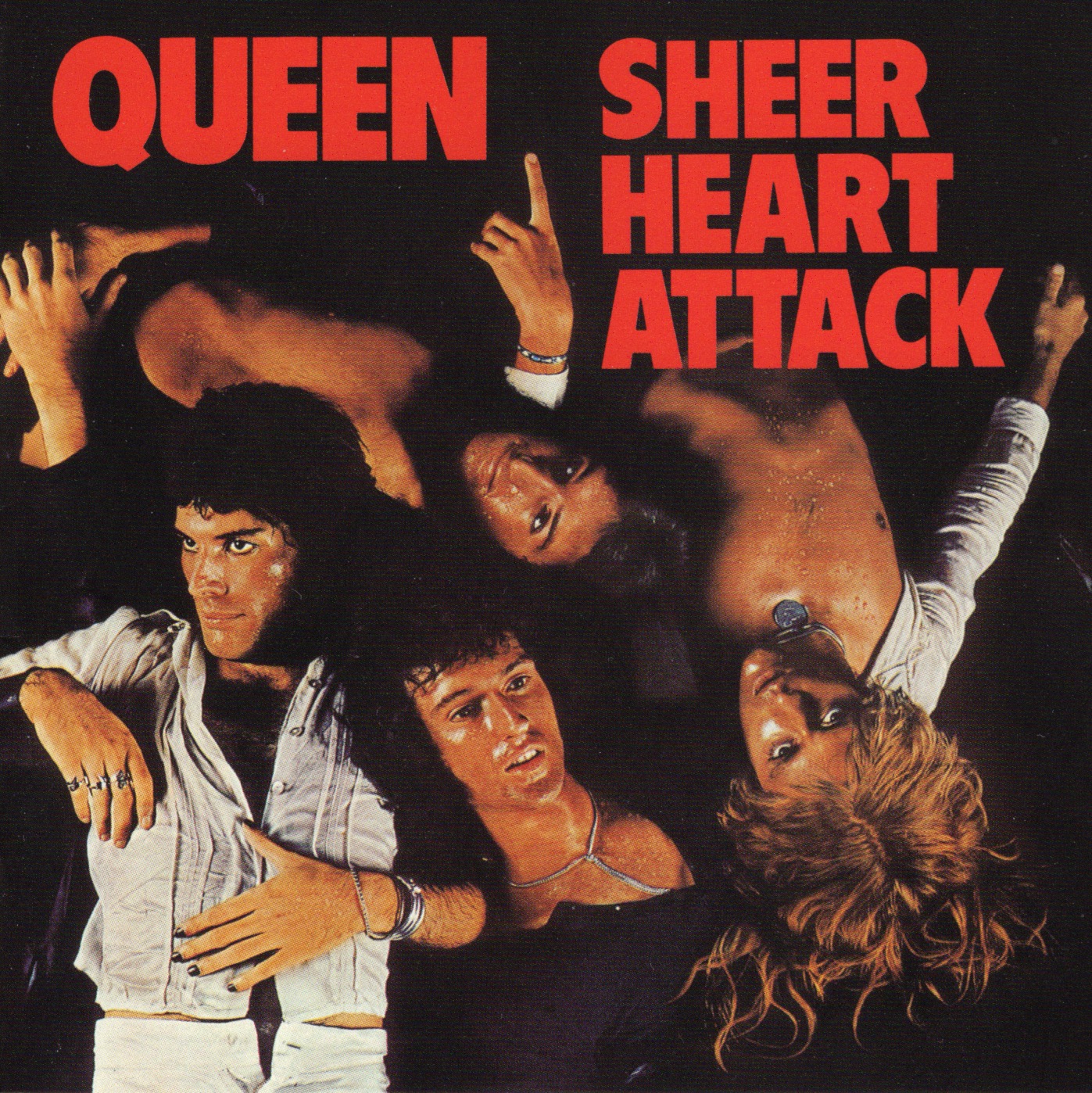
First, let’s ponder that raw, sweaty album cover art. For a band that projected opulence throughout the 1970s, this particular cover is a curious anomaly, and I must admit it put me off the record for decades, as it felt like gas-station-cassette-rack-caliber visuals unbefitting the band or their sound. I understand now that it was conscious marketing, not lazy art direction, and was meant to suggest a gritty, visceral new direction, but I still think a better cover would have elevated this album's reputation—with me, if no one else.

For one thing, it isn't accurate. While the Dungeons & Dragons mysticism that ran rampant through the first two Queen records (leading to cringe-inducing titles like "The Fairy Feller's Master-Stroke") is largely dismissed, it does linger on in diluted form with "Lily Of The Valley," "In The Lap Of The Gods," and "In The Lap Of The Gods…Revisited." Furthermore, the album delivers their first undisputed classic track, which set the template of their success for a decade: characters in a heightened state of sexual/spiritual reality, exalted by a luxuriant musical bed of capricious genre-hopping (refracted through a hard-rock prism), supported by that instantly-recognizable male choir. It could scarcely be more over the top. The track, of course, is "Killer Queen." It works like gangbusters, but could hardly be more at odds with that cover image.

The album cover and title suggest they’ve dispensed with the overblown grandeur, that they’re here to seriously rock your world. And while I would agree there is a notable recalibration happening, I’d say they actually managed to get more serious by taking themselves much less seriously. The pomposity they excelled at musically, when applied to lyrical tales of woodland mythology and other such bullshit, effortlessly hurtled over the fence into the pastures of ridiculousness, and is way-hey-hey too easy to roll one’s eyes at. By taking more modest ideas and blowing them up into towering productions, it makes everyday life feel like an epic adventure, no imps or ogres required.

Take the opener, “Brighton Rock.” In just sixteen lines, songwriter Brian May deftly sketches out a story where two people meet and have a deliciously naughty summer fling. Plot-wise, it’s “Summer Nights” from Grease; it’s Dirty Dancing. Yet when Queen bring their musical prowess to bear, along with some florid throwback phrasings that suggest bygone eras, and Freddie Mercury’s innate theatricality, this threadbare story feels like an event that should be recorded in history books. With some prudent editing of the long guitar solo passage in the middle, it would have made a great single—and a much better choice than what was released as the second single, "Now I'm Here" (also by May).

"Brighton Rock" is followed by the Mercury-penned "Killer Queen," which is followed in turn by "Tenement Funster," written and sung by Roger Taylor. In the 70s, Taylor's contributions to the Queen catalogue provided a facet of the band only known to album listeners. He wrote and sang about one song per album, and they mostly seemed to idealize rock and roll as a pursuit for laid-back, blue-collar guys who were content with scraping by, happy to work on their cars and tool around on their guitars. It's like he had no idea what band he was in. Placing "Tenement Funster" directly after the champagne-and-caviar "Killer Queen" is a humorous contrast, though I'd be surprised if it was intended as such. The song isn't bad, but neither is it one of his more memorable efforts. (Oddly, his excellent song "Sheer Heart Attack," a full-throttle ripsnorter that would have perfectly exemplified this album's aesthetic, isn't included on it—it came three albums later, on 1977's News Of The World.)

"Tenement Funster" flows seamlessly into Mercury's "Flick Of The Wrist"—like, brilliantly seamlessly, where it's difficult to tell where one song ends and the next begins. Transitions are one of this record's strongest aspects, in my opinion, and will be mentioned again. As far as the song itself, it is a interesting case. It was technically a single, and a worthy one at that. It's one of only two or three songs that sounds like the album looks; a tough-minded track where Mercury unloads his wicked vitriol on that familiar rock-and-roll chestnut: the artist being swindled and used by music industry pencil-pushers who are solely focused on profit. Unfortunately for the song’s own fortunes, it was issued as a double A-side with “Killer Queen”—which got all of the airplay and renown, reducing the legacy of “Flick Of The Wrist” to an easily-overlooked footnote.

The album moves on—again via a seamless segue—straight into the delicate “Lily Of The Valley,” which I’d peg as the most successful of the holdover fantasy-tinged songs (all of which were compositions by Mercury). I can excuse the lyrical callbacks to “Seven Seas Of Rhye” as an attempt to extend a mythology that I didn’t care about in the first place, with no harm done. The song steadily swells from a piano-and-voice opening until the full band (plus the men's chorus) join in, without ever undercutting the gentleness of where it began. It serves as a good example of Mercury’s remarkable ability to ignore the conventions of songwriting and follow his muse without question, improbably yielding beautiful music.

[Speculative side note before moving on: While I don't know any of this for a fact, evidence leads me to believe that the band mutually agreed Freddie would be the radio voice of Queen. Drummer Roger Taylor and guitarist Brian May would regularly sing their own compositions, unless (I suspect) they saw some single potential in the song, in which case they'd pass vocal duty over to Freddie. (Bassist John Deacon’s songs were always sung by Mercury, I believe without exception.) I imagine this complicated the politics of putting an album together for Brian May in particular (it feels like Taylor, in his cheap-beer-and-local-girls alterna-Queen, was content to merely have his songs go unchallenged onto the albums, with the understanding that they would never be singles—until the mid-80s, at least, when he noticed the extra income that came with writing a hit single, and started writing poppy fare like “Radio Gaga” and “A Kind Of Magic”). It felt like May would prefer to sing his own songs unless they specifically called for vocal drama that his pedestrian singing voice couldn’t deliver. But he’d have had to intuit the commercial prospects of each song during the recording stage, and (again, in my imagination) wish he could have back any of his Freddie-sung songs that didn’t up getting selected. All of which is a longish defense of my point of view regarding the next paragraph.]

Brian May probably could have kept “Now I’m Here” for himself. It was a single (and thus sung by Freddie), but shouldn’t have been. They have some fun playing with with just where the titular “here” might be during the intro, bouncing the vocals from speaker to speaker. It has some tasty riffing, plus some big lines that are fun to sing along with, but it ultimately isn’t about anything. Or it’s about something so shielded by opaqueness that it doesn’t mean anything to the average listener. As a contrast, “Dragon Attack” (from 1980’s The Game) is filled with even more nonsensical verbiage, but it works because it the song is just about the attitude of its own groove, and the words don’t matter. “Now I’m Here,” on the other hand, hints at concrete things without actually telling us anything: “Don’t worry babe, I’m safe and sound/Down in the dungeon, just Peaches and me.” Later, he’s “Down in the city, just Hoople and me.” At some point, he claims “Your matches still light up the sky, and many a tear lives on in my eye.” And somehow, all of this “made [him] live again.” What? Who is the “you” that is being sung to, who is apparently “America’s new bride-to-be,” but is neither Peaches nor Hoople, whoever they are? What does any of this have to do with being “here” or “there” or anywhere else? It confounds me. Which all makes it sound like I hate it, but I don’t. To my mind, it’s a solid album track that founders under the increased scrutiny of its status as a single. It seems to have been selected for little more reason than Mercury had already had his turn, and was about the right length for a radio song. Any additional snark on my part is due to the fact that it for decades it bolstered my idea of Sheer Heart Attack as “Killer Queen” plus filler Queen. “Brighton Rock,” guys; should have been “Brighton Rock.”

“In The Lap Of The Gods” is the one clunker on the album, to my ears. It kicks off (what was originally side two of the LP) with a sudden searing falsetto from Roger Taylor that startles the crap out of me every time. That epic beginning piles on the drama from there, building with swooning “ooh”s and “ahh”s for almost a minute in getting to a shattering “Leave it in the laaap… OF THE GODS!” [Ed.—They hang on the ‘O’ in “gods” for five solid seconds, but trying to represent that in type makes it read as “goods,” so I couldn’t write it that way. So…yeah.] That process takes us to the :52 mark…and by 1:36, we’re into the resolution and coda. Freddie forgot to stick a song in between those two parts, something to hang the drama on. There’s a great foundation for a song that never materializes—the idea held within the title that we have to accept some things that are out of our control. Instead, we get Mercury singing for 30 seconds in some gloopy character voice which is the one thing on the record that truly irritates me. This perhaps best illustrates the downside of ignoring songwriting conventions. The best thing about the song is the perfect segue into the next track, “Stone Cold Crazy.”

“Stone Cold Crazy” is an absolute highlight, not just for this album, but their entire canon. It’s the only song I can think of credited to all four band members (except for “Under Pressure,” which was additionally credited to Bowie), and it’s a barn-burner that sounds like everyone is having fun, boasting a lean, blistering riff for the ages. You can hear the whole David Lee Roth era of Van Halen in this single two-minute blast. This one has rapid-fire lyrics that don’t do much more than paint a picture of a desperate character on the run, but here it’s all about the unhinged momentum of the song, so it works. This is the other primary song that sounds like what is promised by the album cover.

Then they make a bizarre left turn, putting the album’s closing track next, with four more songs left to go. “Dear Friends” is a minute-long benediction, and very pretty. It feels like an a cappella number (it isn’t; there’s a piano accompaniment). I like it. I like to harmonize along with it. But it’s the kind of truncated snippet of a song that only really works as an opener or closer, and this is clearly a closer. I can’t explain why anybody thought it was a good idea to place after “Stone Cold Crazy,” except as a palate-cleanser. This also leads me to observe that four of the five shortest tracks—all 2:15 or shorter—are bunched together in a row (the fifth, “Lily Of The Valley,” clocks in at 1:45). This really kind of kills the pacing of the last half of the album. (The two longest songs—“Brighton Rock” and “Now I’m Here”—are both on the first half of the album.)

John Deacon’s first contribution to a Queen album as the sole credited songwriter comes next: “Misfire.” There’s an easy joke set up with that title, but really, it isn’t a bad tune. I don’t know I feel that Deacon ever had the songwriting talent of the other three, even though he’d eventually deliver such staples as “You’re My Best Friend” and “Another One Bites The Dust.” My rule of thumb is that if it sounds like a song that the Carpenters could have comfortably covered that same year, there’s a good chance it’s a John Deacon tune. There was probably a time I would have railed against this song’s lightweight pleasantness, more because I needed it to be known that I only liked Queen that rocked than because of any honest assessment of the song. I’ve come to appreciate lightweight over time, though, and “Misfire” at least makes sense to me. It’s inconsequential fluff that’s over in less than two minutes. It’s fine.

“Bring Back Leroy Brown” brings the fun. Its campiness is crucial to the overall record, in my opinion. It’s the forebear of other Vaudevillian volleys of Mercury-penned silliness like “Seaside Rendezvous” and “Good Old-Fashioned Lover Boy,” and is the evidence upon which I base my theory that embracing that they were ready, as a band, to embrace the comedy inherent in their bombastic theatrics, and became a better band because of it. Its presence on the record helps underscore their self-awareness that a song like "Killer Queen" is archly camp, and not deathly serious. That nuance of tone is the critical difference between trying-so-very-hard and coming off as ridiculous, and being so tongue-in-cheek ridiculous that you come off as sublime. It's also super-fun to sing along with, from the actual lyrics to the "woo-woo" for the train noise.

Even though it's only four minutes long, coming as it does on the heels of four songs in just over seven minutes, "She Makes Me" feels like an epic. Weird: Doing this in-depth look at the album has it only just now dawning on me that "She Makes Me" is the sole Brian May lead vocal on it. Plodding and hypnotic, it's my choice for the overlooked classic from the record. It feels like a double-meaning; she "makes" him in the sense that his love for her completes him, and in the darker sense that his devotion makes him totally compliant to her wishes. (The parenthetical subtitle "Stormtrooper In Stillettos" makes a strong argument for the latter interpretation, but whatever.) It's an awkward juxtaposition coming out of the ebullient "Leroy Brown," but I very much enjoy both songs on their own terms. I think "She Makes Me" would have been an interesting choice for a single; its dramatics are in a Moody Blues vein, and would have demonstrated their range. Alas, it would have also violated the (suspected) mandate that Freddie sing the singles.

The album closes on the revisitation of "In The Lap Of The Gods." I can't tell anything it has in common with its predecessor beyond containing the title phrase, and find it to be wholly more satisfying than the first one—but not so strong that it ought to close out the record, especially since "Dear Friends" was so ready to assume that mantle.

Where does that leave me? We have an album that somehow manages to have merge outstanding transitions and questionable sequencing. Do I view it from the standpoint that it contains an incredibly strong twelve (out of thirteen) songs that I can comfortably give a thumbs up, or that I'd rate fewer than half from "very good" to "great"? Many tracks are weighted down by factors beyond their merits as songs. The seamless three-song suite, along with "Brighton Rock" and "Now I'm Here," makes it feel as if all the fully-formed songs were front-loaded, which in turn makes the last half feel woefully underdeveloped, including two completely different takes on the same title that muddies the identity of both. Yet all my very favorites from the album are from that shotgunned second half. They nail the opener, but flub the closer. It was represented in the public consciousness by an all-time classic single, an overlooked single that could have been a classic, an average song that should not have been a single, and a couple of album tracks with untapped single potential. It has an ugly cover that has unduly influenced my feelings about it for many, many years.

In the end, I feel that while it holds many elements that would lead it to be a great album, Sheer Heart Attack doesn't quite coalesce into greatness. But it definitely sets the stage for the string of great releases that came in its wake.